Many store owners look at total sales first.
That is understandable. Sales are easy to see. If the counter is busy and the daily collection looks strong, it feels like the business is doing well.
But total sales do not tell the full story.
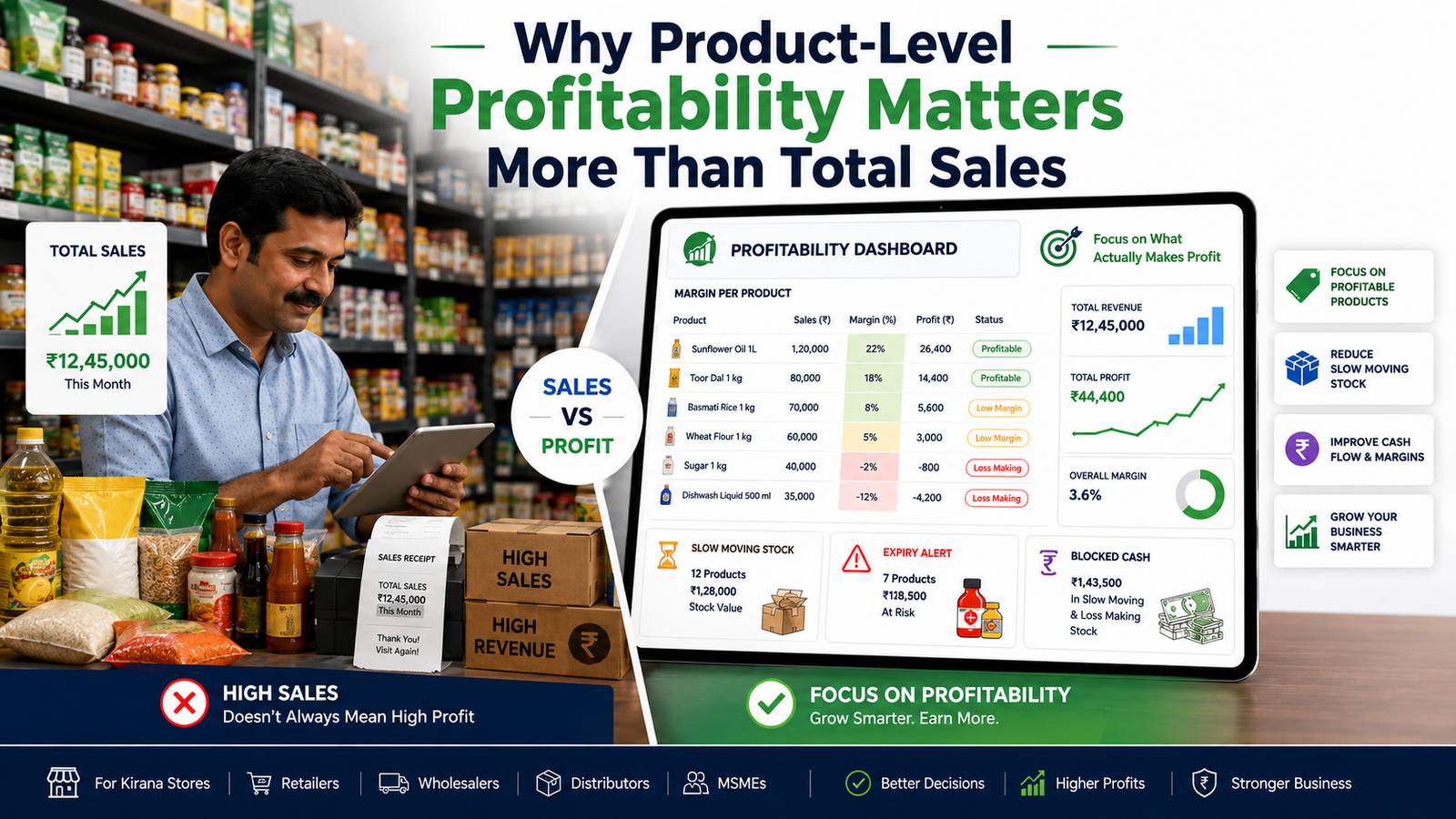
A store can have high sales and still have weak profits. Some products may sell quickly but give very low margins. Some products may look popular but expire often, get damaged, require frequent discounts, or block shelf space. Other products may sell slowly but deliver better profit when managed properly.
This is why product-level profitability matters.
If you only know how much your store sold, you know revenue. But if you know which products actually made money, which ones tied up cash, and which ones quietly reduced margins, you understand the business.
For retail stores, kirana shops, distributors, wholesalers, and growing MSME retailers, product-level profitability can be the difference between “busy” and “profitable.”
Total Sales Can Be Misleading
Total sales show how much money came in.
But they do not show how much money stayed.
That difference is important.
For example, two products may both sell ₹10,000 worth in a month. But one product may have a strong margin while the other may barely cover cost. If the owner only checks sales value, both products look equally successful. In reality, one may be far more valuable to the business.
Total sales ignore several important questions:
What was the purchase cost?
What was the selling price?
What was the gross margin?
How often was the product discounted?
Did any quantity expire or get damaged?
How much shelf space did the product occupy?
How quickly did the product move?
Was money stuck in unsold stock?
A sales number without profitability context can create false confidence.
That is dangerous because owners may continue restocking products that sell but do not contribute enough profit.
Revenue Is Not Profit
This is the mistake many businesses make.
Revenue is the amount earned from sales. Profit is what remains after costs.
A product with high revenue can still be a weak product if the margin is poor. Similarly, a product with lower sales volume may be valuable if it has strong margin, consistent movement, and low wastage.
Retailers need to understand both:
how much a product sells,
how much a product earns.
A store that only tracks sales may focus too much on fast-moving items and ignore whether those items are actually worth pushing.
Product-level profitability helps answer the better question:
Which products are actually helping the business grow?
That question matters more than “Which products sold the most?”
Some Products Sell Fast but Make Little Money
Fast-moving products are important. They bring customers into the store and keep daily sales active.
But fast-moving does not always mean high-profit.
Some products may sell quickly because they are essentials, but their margins may be thin. Others may need competitive pricing because nearby stores sell the same item. Some may require frequent offers or discounts just to move.
If the store treats every fast-moving product as a top performer, it may make poor stocking decisions.
For example:
a product may sell daily but give very low margin,
another may sell weekly but give better profit per unit,
one product may bring footfall but not profit,
another may deserve more shelf space because it earns better.
Without product-level profitability, these differences are hard to see.
The owner may keep focusing on the loudest sales numbers instead of the strongest business results.
Slow-Moving Products Block Cash
Not every loss comes from selling at low margin.
Some losses happen because products do not move.
Slow-moving stock blocks cash. The money used to purchase those products is stuck until they sell. Meanwhile, the store may need cash for faster-moving products, supplier payments, rent, staff, or daily operations.
Slow-moving stock also uses shelf space. In a retail store, shelf space is not free. Every product occupying space should justify itself.
When products sit too long, they create problems:
cash is blocked,
shelf space is wasted,
expiry risk increases,
dust and damage risk increases,
purchase decisions become harder,
working capital becomes weaker.
Product-level profitability should not only look at margin. It should also consider movement.
A high-margin product that rarely sells may not be as useful as it looks. A lower-margin product that moves reliably may still be valuable. The goal is to understand the balance.
Expiry and Write-Offs Change the Real Profit
Some products look profitable until expiry and write-offs are considered.
For example, a product may have a good margin on paper. But if a portion of the stock regularly expires, gets damaged, or needs to be written off, the real profitability is lower.
This is common in categories like:
dairy,
packaged food,
bakery items,
cosmetics,
medicines,
perishable grocery items,
seasonal goods.
If expiry losses are not connected to product performance, the owner may keep buying the same product without realizing it is reducing profit.
That is why profitability analysis should be connected with inventory movement, batch tracking, and alerts.
A product is not truly profitable just because its selling price is higher than its cost. It is profitable only if it sells at the right time, in the right quantity, with manageable waste.
Product-Level Profitability Helps You Stock Smarter
Better stocking is not just about filling shelves.
It is about putting money into the right products.
Product-level profitability helps store owners make smarter decisions such as:
which products to reorder,
which products to reduce,
which products to stop buying,
which products need better pricing,
which products deserve more shelf space,
which supplier prices need renegotiation,
which products should be promoted,
which products are tying up too much cash.
This gives the owner more control.
Instead of ordering based on habit, pressure, or guesswork, the business can order based on actual performance.
That is how inventory becomes strategic.
Profitability Data Improves Supplier Decisions
Suppliers influence product profitability more than many store owners realize.
If the purchase price increases but the selling price stays the same, margins shrink. If one supplier consistently offers better pricing, more reliable delivery, or fewer quality issues, that affects profitability.
Product-level analysis helps store owners ask sharper supplier questions:
Which supplier gives the best cost for this product?
Has the purchase cost increased recently?
Is the margin still acceptable?
Are supplier delays causing stockouts?
Are quality issues causing returns or write-offs?
Should this product be sourced differently?
Without this data, supplier management becomes reactive.
The owner may continue buying from the same supplier because it is familiar, not because it is profitable.
Good reporting makes supplier decisions more objective.
Profitability Is Better Than Guesswork
Many store owners have strong instincts. That is valuable.
But instinct alone is not enough when a store has hundreds or thousands of products.
It is easy to remember the products that sell often. It is harder to remember:
exact margin,
stock age,
expiry losses,
movement trends,
supplier cost,
discount frequency,
customer demand changes.
Product-level profitability turns scattered information into something useful.
It helps the owner see patterns that may not be obvious during daily operations.
For example:
a popular product may be less profitable than expected,
a quiet product may be a strong margin contributor,
a category may be overstocked,
one supplier may be affecting margins,
a product may need price correction,
certain items may be better removed from regular purchasing.
This kind of visibility helps the store move from guesswork to informed decisions.
Total Sales Do Not Show Product Mix Quality
Product mix matters.
A store’s product mix is the combination of items it sells. Two stores may have the same total sales but very different profitability depending on what products make up those sales.
A good product mix includes:
reliable fast-moving items,
profitable margin products,
essentials that bring customers in,
low-waste products,
products with healthy supplier terms,
items that match local demand.
A weak product mix may include:
too many slow-moving items,
low-margin products taking too much shelf space,
expiry-prone products ordered in excess,
products with poor supplier pricing,
items that sell only with discounts.
Product-level profitability helps improve product mix over time.
It shows what deserves attention and what needs correction.
Reports Should Help You Decide, Not Just Display Data
Many systems can show reports.
But not every report helps the owner make decisions.
A useful retail report should answer practical questions:
What is selling?
What is profitable?
What is stuck?
What is running low?
What is overstocked?
What is nearing expiry?
Which products should be reordered?
Which products should be reviewed?
Which supplier relationships affect margins?
This is where product-level profitability becomes valuable. It turns reports into decisions.
The goal is not to create complicated dashboards. The goal is to help the store owner take better action.
If a report does not help the business decide what to do next, it is just decoration.
How Arenvera Inventory Helps
Arenvera Inventory helps store owners go beyond total sales by connecting product data, stock movement, billing, reports, and analytics.
It supports product-level analysis, helping businesses understand profitability at the item level instead of only looking at total revenue. It also connects inventory with suppliers, purchase orders, billing, reports, stock alerts, and location-wise tracking.
This gives the store a clearer picture of how products are actually performing.
With Arenvera, store owners can better understand:
which products are moving,
which products are profitable,
which products need attention,
which items may be overstocked,
which products are linked to expiry or stock risk,
where inventory value is sitting,
which reports can support better buying decisions.
Instead of relying only on sales totals, owners can make decisions based on clearer product-level data.
That means smarter stocking, better purchasing, and more control over margins.
Final Thoughts
Total sales are important, but they are not enough.
A busy store is not always a profitable store. High revenue does not automatically mean strong margins. Fast-moving products are not always the best products. Slow-moving stock can quietly block cash. Expiry and write-offs can erase profit that looked good on paper.
Product-level profitability helps store owners see the truth behind the sales number.
It shows which products are worth restocking, which need review, which may be reducing margins, and where the business can make better decisions.
If you only track total sales, you may know how much your store sold.
But if you track product-level profitability, you understand how your store actually earns.
That is the difference between running a busy store and running a smarter business.
Want to know which products actually make money?
Arenvera Inventory helps you understand product-level performance, stock movement, reports, and profitability so you can stock smarter and protect margins.
MORE FROM US


Leave a Reply