Retail losses rarely announce themselves loudly.
Most of the time, they build slowly.
A fast-moving product runs out before anyone notices. A box of goods sits in storage until it expires. A shelf remains empty during peak hours even though stock exists in the back room. A supplier order gets delayed because nobody realized the item had reached a critical level.
These are not rare problems. They are everyday problems in retail.
For kirana stores, general stores, grocery shops, distributors, and small retailers, low stock and expiry issues can quietly reduce profit, damage customer trust, and create avoidable waste.
That is why low stock and expiry alerts are not just “nice-to-have” features. They are practical loss-prevention tools.
A good alert system helps store owners and staff act before small inventory issues become expensive problems.
The Real Cost of Finding Out Too Late
Many store owners only discover inventory problems when it is already too late.
A customer asks for a product, and only then does the staff realize it is out of stock.
A supplier visit is missed because nobody prepared the reorder list.
A product reaches expiry before anyone moves it to the front shelf.
A shelf looks stocked, but the actual saleable quantity is low.
The problem is not always negligence. Most stores are busy. Staff are handling billing, customers, deliveries, phone calls, returns, and restocking at the same time.
Without automatic alerts, the store depends on memory and manual checking.
That is risky because memory does not scale.
As the number of products grows, it becomes impossible to manually track every item, batch, expiry date, and reorder need accurately.
Low Stock Alerts Protect Sales
Low stock alerts help identify products that are about to run out.
This matters because stockouts directly affect sales. When a customer cannot find what they need, they may buy from another shop. If that happens repeatedly, the store loses more than one sale — it loses reliability.
A low stock alert gives the store time to act.
Instead of discovering the problem after the shelf is empty, the owner or staff can reorder early, transfer stock from another location, or restock the shelf from storage.
Low stock alerts are especially useful for:
1)fast-moving grocery items,
2)daily-use products,
3)high-demand seasonal items,
4)products with supplier delays,
5)items stored across multiple locations,
6)products that customers expect to always be available.
The point is simple: if an item is important to daily sales, the store should not wait until it disappears.
A proper alert system should warn the team before the product reaches a dangerous level.
Expiry Alerts Reduce Waste
Low stock is one kind of loss. Expired stock is another.
For grocery stores, food businesses, FMCG retailers, pharmacies, and general stores, expiry can directly destroy profit. Once a product expires, it may no longer be saleable. The money spent on purchasing, storing, and displaying that item is lost.
Expiry issues usually happen because older stock is not tracked properly.
Common causes include:
1)new stock placed in front of older stock,
2)expiry dates not checked regularly,
3)batches mixed together,
4)slow-moving products ignored,
5)staff not knowing which stock should move first,
6)products sitting in storage while newer items are sold.
Expiry alerts help solve this by highlighting products that are nearing expiry.
This gives the store time to act. The team can move older batches forward, promote near-expiry goods where appropriate, transfer stock, adjust purchase quantities, or stop over-ordering the same product.
The goal is not just to know what expired. That is too late.
The goal is to know what may expire soon.
That is where alerts become valuable.
Batch-Level Tracking Makes Expiry Alerts More Useful
Expiry alerts are most effective when they are connected to batch-level tracking.
A product name alone is not enough.
For example, a store may have multiple batches of the same product:
1)one batch expiring this month,
2)another batch expiring next month,
3)a fresh batch received yesterday.
If the system only tracks total quantity, the expiry risk remains hidden. The owner may think there is enough stock, but not realize that part of it needs urgent movement.
Batch-level tracking gives more control.
It helps the store know:
1)which batch was received,
2)how much quantity is in each batch,
3)what the expiry date is,
4)which batch should be sold first,
5)where the batch is located.
This is especially important for stores that handle food, dairy, packaged goods, medicine, cosmetics, or any product with shelf life.
Without batch-level visibility, expiry control becomes guesswork
Alerts Reduce Dependence on the Owner’s Memory
In many small stores, the owner is the system.
The owner remembers what is low, what sells fast, which supplier to call, which products expire quickly, and which items need attention.
That may work for a while. But it creates a dangerous dependency.
If the owner is away, busy, tired, or handling another part of the business, mistakes happen.
A good alert system reduces this dependency by giving staff a clear list of what needs action.
Instead of asking:
“What should we reorder?”
the team can check alerts.
Instead of wondering:
“Which items are near expiry?”
the system can highlight them.
Instead of waiting for the owner to inspect every shelf, staff can act based on visible priorities.
This is how stores become more organized. Not by working harder, but by making important information easier to see.
Alerts Should Lead to Action
A weak alert system only tells you there is a problem.
A strong alert system helps you do something about it.
For example, if an item is low in stock, the next step may be:
create a purchase order,
reorder from a preferred supplier,
transfer stock from warehouse to store,
restock the shelf,
check recent sales movement.
If an item is nearing expiry, the next step may be:
move older batches forward,
transfer stock to a faster-moving location,
reduce future purchase quantity,
review product performance,
write off damaged or expired goods with a reason.
Alerts should not become another list that nobody checks.
They should become a daily action center.
This is where many retail systems fail. They show information, but they do not fit into the store’s workflow.
Good inventory software should help the team move from problem to action quickly.
Low Stock Alerts Improve Purchase Planning
Purchasing is one of the most important parts of retail.
Order too late, and you lose sales.
Order too much, and you block money.
Order the wrong product, and shelf space gets wasted.
Low stock alerts make purchase planning more disciplined.
They help store owners avoid panic ordering and guess-based ordering. Instead of relying on rough memory, the owner can see which items actually need attention.
This is especially useful when suppliers have delivery delays or minimum order quantities.
A good system can help the store prepare better purchase orders by showing:
what is running low,
what supplier is linked to the product,
what products are already overstocked,
what items are moving quickly,
what should be reordered first.
This reduces unnecessary purchases and improves cash flow.
Expiry Alerts Help Improve Stock Rotation
Expiry alerts also improve stock rotation.
In retail, stock should not just sit wherever it is placed. Older stock usually needs to move first. This is especially important for products with expiry dates.
A store that does not track batches properly may accidentally sell newer stock first while older stock remains hidden behind it.
This increases waste.
Expiry alerts help staff identify which stock needs attention. Combined with FIFO-style movement, they make it easier to sell or move older stock before it becomes unsaleable.
This is not just about reducing waste. It is also about creating discipline in store operations.
The more organized the stock movement, the fewer surprises the store faces.
Alerts Are Even More Important Across Multiple Locations
If a business has only one shelf, manual checking may still work for some time.
But once stock is spread across locations, alerts become far more important.
A retailer may have products in:
front shelves,
backroom storage,
warehouse,
another outlet,
external storage,
goods in transfer.
Without proper alerts, one location may run out while another has excess stock.
This leads to unnecessary purchases and missed sales.
A better system should show where the problem is.
For example:
shelf stock may be low,
warehouse stock may be available,
a transfer may solve the issue,
no supplier order may be needed.
This is why alerts should work with location-wise inventory tracking.
The store does not just need to know that stock is low. It needs to know where stock is low and what action makes sense.
What a Good Retail Alert System Should Include
A useful alert system should be practical, not complicated.
For small and growing retail stores, the most important alerts usually include:
low stock alerts,
near-expiry alerts,
shelf restocking alerts,
reorder reminders,
batch-level expiry tracking,
unread alert counts,
quick action links,
supplier or purchase order connection,
stock transfer actions,
issue reporting.
The system should also be easy for staff to understand.
If alerts are buried deep inside complicated menus, they will not be used. The best alerts are visible, clear, and connected to action.
How Arenvera Inventory Helps
Arenvera Inventory is built to help stores act before stock problems become losses.
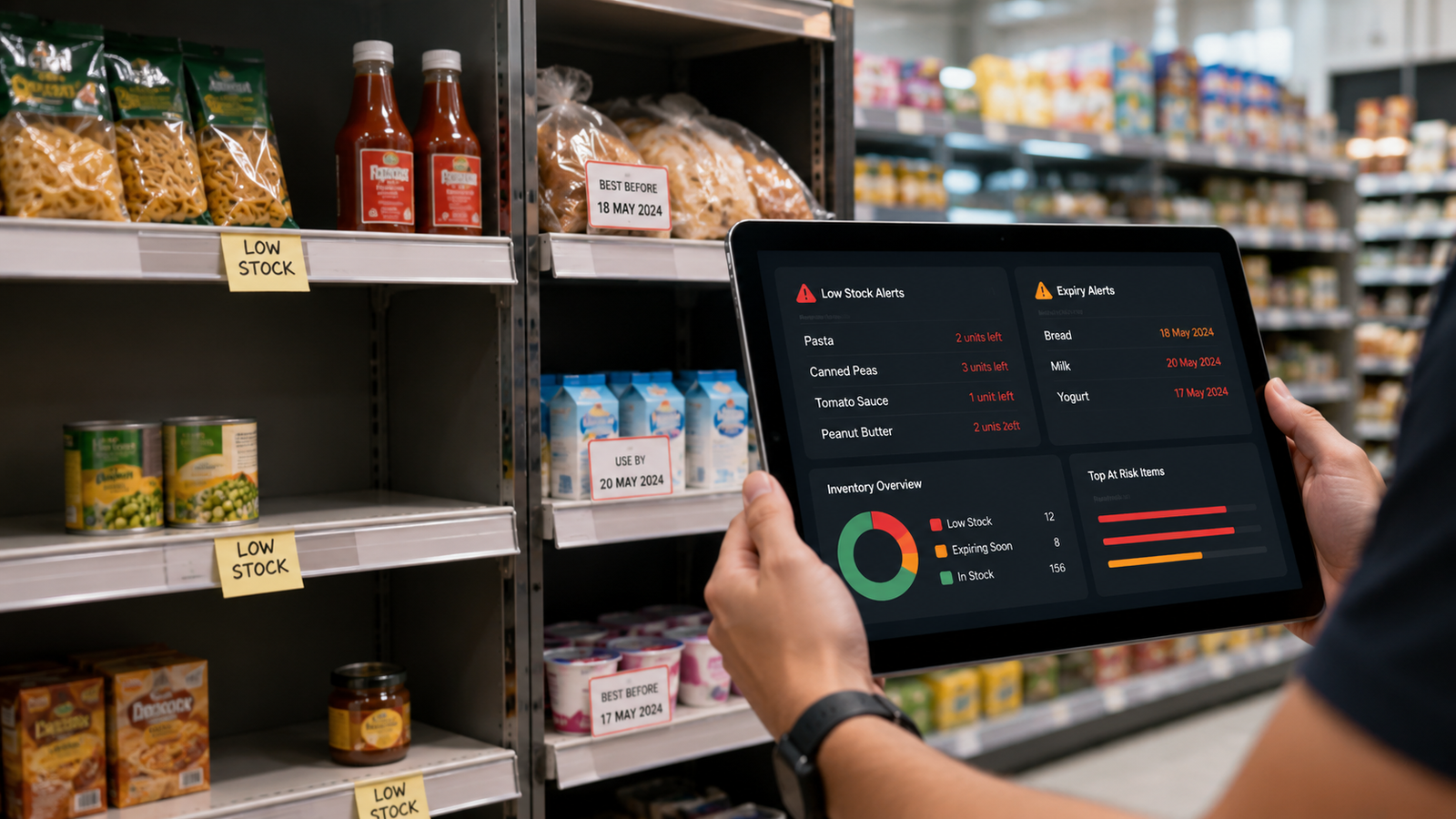
It includes a dedicated alerts section for urgent inventory actions, including low stock, expiry risks, restocking needs, and reorder opportunities. It also supports batch-level control with expiry dates, helping stores identify products that need attention before they become unsaleable.
The system connects alerts with the rest of the inventory workflow, including stock operations, purchase orders, suppliers, billing, reports, and location-wise tracking.
This means alerts are not isolated warnings. They are part of the daily store management process.
With Arenvera, store owners and staff can:
1)identify low-stock items earlier,
2)track expiry risks,
3)restock shelves more confidently,
4)reorder products faster,
5)reduce avoidable waste,
6)improve purchase planning,
7)manage stock across locations,
8)reduce dependence on manual checking.
For retail businesses, that kind of visibility can make a real difference.
Final Thoughts
Low stock and expiry problems are not minor issues.
They affect sales, customer trust, cash flow, shelf space, and profit.
The problem is that they often become visible only after the damage is done. A customer leaves because the product is unavailable. A batch expires because nobody noticed it in time. A purchase is delayed because no one prepared the reorder list early enough.
Alerts change that.
They help store owners and staff act before problems become losses.
A good inventory system should not only record what happened yesterday. It should help the store prepare for what needs attention today.
That is the real value of low stock and expiry alerts.
They turn inventory management from a reactive task into a proactive system.
Prevent stock problems before they become losses
Arenvera Inventory helps you spot low stock, expiry risks, restocking needs, and reorder actions early, so your team can act before sales or products are lost.
More From Us

Leave a Reply